How to Calculate CBM for Shipping Containers: 2026 Guide
Table of Contents
- What Is CBM and Why It Drives Your Shipping Costs
- How to Calculate CBM for Shipping: Step-by-Step
- Use a CBM Calculator for Shipping to Save Time
- Shipping Container Capacity: 20ft, 40ft, and High-Cube
- How Many Pallets Fit in a 40ft Container?
- Volumetric Weight vs CBM: Which One Carriers Actually Charge
- FCL vs LCL: Choosing the Right Option Based on Your CBM
- Packaging Optimization and Irregular Cargo: Protecting Your CBM Calculation
Last Updated: August 6, 2026
What Is CBM and Why It Drives Your Shipping Costs
CBM is cubic meters, the standard unit of volume measurement used across international freight to determine how much space your cargo occupies in a shipping container or aircraft hold. Every rate quote ties back to this number.
Carriers care as much about volume as weight. A light but bulky shipment is often charged on volume rather than weight, and an incorrect CBM calculation means incorrect freight costs. CBM is calculated by multiplying a package's length, width, and height in meters. Get that number wrong, and you'll either overpay or underestimate your load and face costly re-quotes at the port.
This guide walks through the exact formula, container capacity benchmarks, and packaging decisions that protect your calculation from the start.
How to Calculate CBM for Shipping: Step-by-Step
Calculating CBM is a three-step process: measure your cargo in consistent units, apply the volume formula, then multiply by the number of cartons or pieces.

Step 1: Measure Length, Width, and Height
Measure the outer dimensions of your carton or pallet, not the product inside. Carriers charge on the exterior footprint, including any protruding corners, handles, or packaging reinforcements.
Use meters for direct entry into the CBM formula. If your facility measures in centimeters, convert in the next step. Record all three dimensions for every unique carton size. A common mistake is measuring only the product and forgetting packaging adds 2-5 centimeters per side.
Step 2: Apply the CBM Formula
The CBM formula is:
CBM = Length (m) × Width (m) × Height (m)
If your measurements are in centimeters, divide each dimension by 100 before multiplying:
CBM = (Length cm × Width cm × Height cm) ÷ 1,000,000
Example: A carton measuring 60 cm × 40 cm × 50 cm
- In meters: 0.60 × 0.40 × 0.50 = 0.12 CBM
- In centimeters: 60 × 40 × 50 = 120,000 ÷ 1,000,000 = 0.12 CBM
Step 3: Calculate Total CBM for Multiple Cartons
Multiply the CBM per carton by the number of identical cartons, then add the results for each unique size.
Total CBM = (CBM per carton) × (Quantity of that carton)
Example with two carton types:
- Carton A: 0.12 CBM × 200 cartons = 24.00 CBM
- Carton B: 0.08 CBM × 150 cartons = 12.00 CBM
- Total: 36.00 CBM
Use a CBM Calculator for Shipping to Save Time
Manual calculation works for a single carton type but becomes tedious with multiple SKU sizes and mixed pallets. A CBM calculator for shipping automates the arithmetic and reduces transcription errors.
A purpose-built freight calculator provides context beyond a standalone CBM number. It tells you whether that volume fits a 20ft container, what the LCL rate looks like at current market levels, and how volumetric weight compares to actual weight for air shipments.
Shipping Container Capacity: 20ft, 40ft, and High-Cube
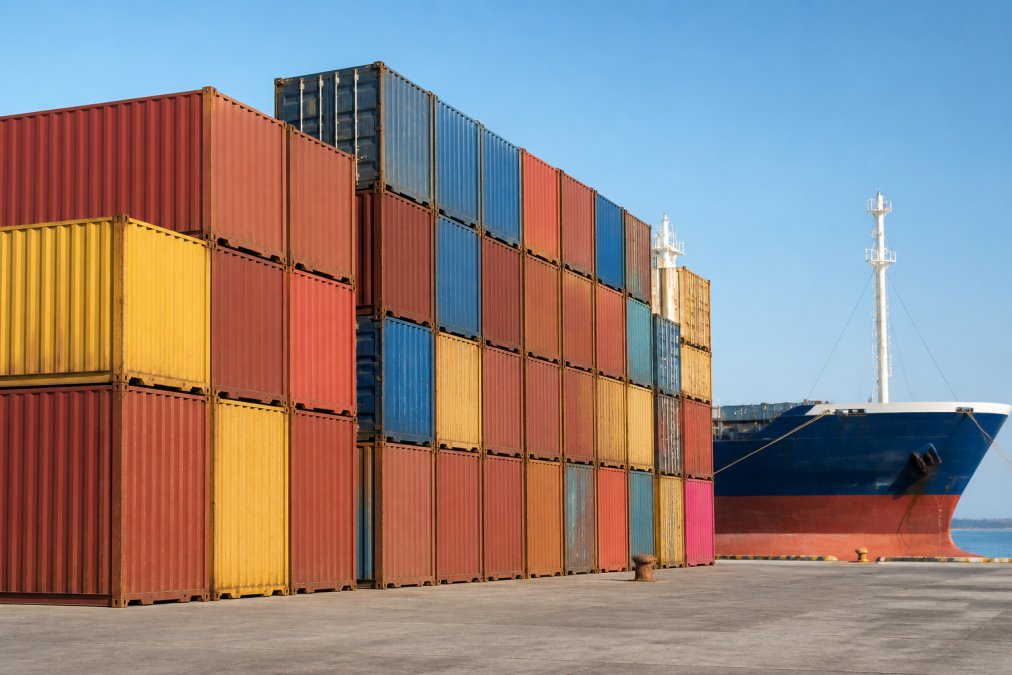
Standard intermodal containers come in three configurations covering the vast majority of ocean freight shipments. Understanding their usable internal volume is essential for deciding whether your CBM total justifies a full container load.
| Container Type | Internal Length | Internal Width | Internal Height | Usable Volume (approx.) |
|---|---|---|---|---|
| 20ft Standard | 5.90 m | 2.35 m | 2.39 m | ~25-28 CBM |
| 40ft Standard | 12.03 m | 2.35 m | 2.39 m | ~55-58 CBM |
| 40ft High-Cube | 12.03 m | 2.35 m | 2.69 m | ~60-67 CBM |
Usable space is lower than theoretical internal volume because cargo must be loaded with structural clearance. A practical load factor of 85-90% of stated capacity is reasonable for general cargo planning.
High-cube containers add approximately 30 centimeters of internal height. For lightweight, voluminous cargo like furniture, textiles, or foam products, that extra height can mean fitting a shipment in one container versus booking a second one.
According to U.S. Customs and Border Protection container standards, all intermodal containers entering US ports must comply with specific structural and sealing requirements.
How Many Pallets Fit in a 40ft Container?
A standard 40ft container holds approximately 20-24 standard pallets in a single-layer floor configuration. Most US domestic pallets measure 48 inches × 40 inches (approximately 1.22 m × 1.02 m). Laid out on a 40ft container floor, you can typically fit two rows of 10-11 pallets running the length of the container.
Variables that change this number:
- Pallet height and weight: Double-stacking requires cargo that can bear the load of another pallet above it.
- Pallet type: Euro pallets measure 1.20 m × 0.80 m and fit more efficiently in some configurations.
- Usable ceiling height: A standard 40ft container provides about 2.39 m of internal height. Two-pallet stacks typically require at least 2.20 m of total height clearance.
For a 40ft high-cube container, the additional height often allows double-stacking where a standard container cannot. Pallet capacity planning and CBM planning are separate exercises. You can fill the floor footprint but only use 40 CBM of a 58 CBM capacity, wasting vertical space.
Volumetric Weight vs CBM: Which One Carriers Actually Charge
For ocean freight, CBM drives the rate. For air freight, carriers charge whichever is greater: actual weight or volumetric weight.
Volumetric weight converts cargo volume into a weight equivalent so carriers can price bulky-but-light shipments fairly. The standard conversion factor for air freight is:
Volumetric Weight (kg) = CBM × 167
Or, if working in centimeters:
Volumetric Weight (kg) = (L cm × W cm × H cm) ÷ 6,000
Example: A carton of 60 cm × 40 cm × 50 cm with an actual weight of 8 kg
- Volumetric weight: 60 × 40 × 50 ÷ 6,000 = 20 kg
- Actual weight: 8 kg
- Carrier charges on: 20 kg (the higher figure)
For seafreight, LCL carriers typically quote per CBM or per ton, whichever is greater, using a 1 CBM = 1 metric ton equivalency for rate comparison.
According to the International Air Transport Association's cargo standards documentation, volumetric weight calculations are standardized across member airlines.
FCL vs LCL: Choosing the Right Option Based on Your CBM
FCL (Full Container Load) and LCL (Less than Container Load) are the two primary ocean freight models. Your CBM total is the primary variable determining which makes financial sense.
FCL means you book an entire container exclusively for your cargo. You pay for the container regardless of how full it is.
LCL means your cargo shares container space with other shippers' goods. You pay only for the CBM your shipment occupies, plus handling fees.
The crossover point where FCL becomes cheaper than LCL varies by route and carrier, but many use a threshold around 15 CBM. Below that, LCL usually wins on cost. Above it, FCL often becomes competitive and reduces handling risk.
| Shipment Volume | Typical Best Option | Key Advantage |
|---|---|---|
| Under 5 CBM | LCL | Pay only for space used |
| 5-15 CBM | LCL or FCL (compare rates) | Route and timing dependent |
| 15-28 CBM | FCL (20ft container) | Fewer handling touchpoints |
| Over 28 CBM | FCL (40ft or high-cube) | Best rate per CBM |
LCL shipments are handled multiple times at consolidation warehouses. Each handling event is an opportunity for damage. For fragile cargo, high-value goods, or shipments with strict delivery windows, FCL often makes sense even at lower CBM totals.
According to the Federal Maritime Commission's guide to ocean shipping options, US importers and exporters have specific rights regarding freight contracts and rate transparency.
Packaging Optimization and Irregular Cargo: Protecting Your CBM Calculation
Packaging optimization reduces external carton dimensions to minimize CBM without compromising product protection. On a 40ft container load, shaving 5 cm off carton height can fit an additional row, potentially reducing CBM enough to shift from a 40ft to a 20ft container.
Practical packaging optimization steps:
- Audit current carton sizes against actual product dimensions
- Identify cartons with more than 10 cm of void fill on any dimension
- Test alternative carton configurations that reduce the largest dimension
- Recalculate CBM with optimized dimensions before finalizing your quote
Irregular and non-stackable cargo requires a different approach. For machinery, large furniture, or oddly shaped industrial components:
- Measure the maximum extent in each dimension, including protrusions
- Add clearance for blocking and bracing materials required for ocean transit
- Treat each irregular piece as its own CBM calculation
- Flag non-stackable cargo explicitly with your forwarder
For non-stackable cargo, you're effectively paying for the full vertical height of the container for that footprint, even if goods only reach half that height.
The National Cargo Bureau's cargo securing guidance provides US-specific standards for blocking, bracing, and securing irregular cargo in intermodal containers.
Accurate CBM calculation is the foundation of every reliable freight quote. Without it, you're guessing at container requirements and making sourcing decisions on incomplete data. Freight-Calculator.com, backed by 35 years of international logistics expertise and operating as a licensed NVOCC and TSA-approved forwarder, gives you instant rate calculations for LCL, FCL, and air freight in under 30 seconds, no registration required. Get started with Freight-Calculator.com and turn your CBM total into a precise, actionable freight quote before your next shipment.
Frequently Asked Questions
What is the formula for calculating CBM?
CBM stands for cubic meters. The formula is: Length (m) × Width (m) × Height (m) = CBM. If your measurements are in centimeters, divide each dimension by 100 before multiplying, or divide the final result by 1,000,000. For example, a carton measuring 50 cm × 40 cm × 30 cm equals 0.06 CBM. To calculate CBM for shipping multiple identical cartons, multiply the single-carton CBM by the total carton quantity.
How many CBM can fit in a 20ft container?
A standard 20ft dry container has a total volume of roughly 33 cubic meters. In practice, usable space after accounting for container walls and load factor is closer to 25-28 CBM of actual cargo. Cargo shape, stacking restrictions, and weight limits all affect how much of that volume you can realistically fill. Freight forwarders typically plan at around 25 CBM for a comfortably loaded 20ft container to stay within safe weight limits.
Is CBM the same as weight in shipping?
No. CBM measures volume, not mass. Carriers charge based on whichever is greater: actual weight in kilograms or volumetric weight calculated from dimensions. For ocean freight, the chargeable unit is usually CBM or metric tons, whichever is higher. For airfreight, carriers apply a dimensional weight conversion factor, typically 1 CBM equals 167 kg. A large but light shipment will often be charged on volume, while a dense, heavy shipment will be charged on actual weight.
How do I calculate CBM for irregular-shaped cargo?
For irregular cargo such as machinery, sculptures, or oddly shaped crates, measure the longest point of each dimension: maximum length, maximum width, and maximum height. Treat it as if it fits inside a rectangular box defined by those outer measurements. That bounding-box volume is what carriers charge for, because the space that cargo occupies in a container cannot be used by other freight. If possible, custom crating to reduce the bounding box size can lower your shipping costs meaningfully.
This article was written using GrandRanker

Comments
Post a Comment